
Wrecking the Foundation
Willful blindness to public goods and the Trumpist attacks on science

Some years ago, a colleague and I and a few others were invited to dinner at the home of a wealthy couple, potential donors to the university. The husband had made his money as CEO of a large company.
At some point in the evening’s conversation, he told the small group of us present how their home had been damaged by a fire years earlier. He recounted that he had been impressed by the bravery and effectiveness of the firefighters who had come and put it out. He then remarked that it was the only time he could remember when he had felt that he got something for all the taxes he paid.
Later, it occurred to me that I could have said that his taxes had paid for a great deal that he took for granted. Roads and bridges; the internet; the educations of most of his former employees; the police and military who kept him safe; and so on. That his wealth, whatever credit he might deserve for it, was made possible by the stable and functioning society in which he had acquired it, which in turn depended on many public services provided by the government. In fact, though I didn’t realize it at the time, his former company itself had held many large government contracts, so taxpayer funds had contributed to its profits directly and substantially.
In the moment, I was stunned, and silent. And I struggle to this day to understand how this intelligent, educated and knowledgeable man could have expressed the view he did, though I am acutely aware that he’s not alone in holding it.
I suppose it’s easy to take things for granted when they are constants in the backgrounds of our lives. The quiet work our institutions do well day after day, year after year, are less visible to us than their flaws are.
Of course the flaws are there. There are plenty of ways and instances in which the public sector fails us. But it’s one thing to complain that some arm of the government is inefficient, ineffective, or in need of reform. It’s another entirely to say that it does nothing of value at all.
Perhaps it becomes easier to think this way the wealthier we are, as then more of our needs and desires are met by private suppliers who cater to us more directly. Perhaps that makes us bristle more when government agencies treat us as just one of the masses. A firefighter saving our home, as a public servant who helps us in a big, visible and personal way, may be the exception. It’s harder to feel gratitude for the Post Office, the DMV, or the IRS. And those are the most visible ones; we don’t see most government agencies at all, most of the time.
We don’t see the foundations of the buildings in which we live and work, either. But we would be in trouble if they weren’t there.
Once you tell yourself that public institutions accomplish nothing at all, though, it’s apparently not such a big leap to become convinced that they should be dismantled. If we can’t or won’t see what they do, we won’t anticipate the disruption and harm that will result when they stop doing it. Experts may warn us, but if we see those experts as part of the same system that we already don’t value, we’re going to ignore them too.
An example: President Trump and his inner circle had heard reasons why attacking Iran would be a bad idea and thus why past administrations hadn’t done it. The regime would be unlikely to be dislodged, and could then kneecap the world economy by closing the strait of Hormuz to ship traffic. They figured, it seems, that the experts who had made that determination were products of dysfunctional institutions, wastes of taxpayer money. The President had fired them, excluded them from the decision-making process, or intimidated them into silence, such that he was surrounded only by those who told him what he wanted to hear.
On April 24, abruptly and with no warning, the White House fired all 22 members of the National Science Board, the independent body that oversees and advises the National Science Foundation.
The NSF was designed to be independent of short-term political currents, on the understanding that science will work best if scientists are, to a substantial degree, in charge of it. The NSB was the buffer designed to maintain that independence.
The elimination of the NSB was just one act of destruction against American science among many in the last year and a half, beginning with Musk and DOGE in the early months and continuing to the present. Grants have been canceled for political reasons; large numbers of civil servants fired; advisory boards and research arms dismantled (at other agencies as well as NSF, e.g., EPA); legal requirements to consider science in policy ignored; and moves made towards closing entire national laboratories, including the National Center for Atmospheric Research in my own field.
The actions have been rapid, indiscriminate, and vindictive (and often, illegal). They give the clear impression that this Administration simply hates science, or at least hates scientists. The Administration, of course, doesn’t say exactly that. Their position seems to be, more or less, that scientists who are supported by the taxpayer should serve the priorities of the Administration.
Many of those priorities, though — on climate, on vaccines, on most environmental and public health issues — are at odds with the views of most scientists who work in the relevant fields, as expressed through the institutional processes of synthesis reports, advisory boards, and so on. When the consensus views of the scientific community don’t seem to support the Administration’s position, the Administration sometimes makes weak efforts to argue their cases on the evidence, or weak legal procedural arguments (as in the case of the NSB, where it has argued that the board was unconstitutional because its members weren’t confirmed by the Senate). But mostly they just fire the scientists. There’s currently no head of either the Food and Drug Administration or Center for Disease Control and Prevention, nor a surgeon general, for example.
And they choke off the funding. So far this year, despite the NSF having been funded by Congress at a level similar to previous years (in spite of a President’s budget request that had proposed catastrophically drastic cuts; Republican Congresses, including even the present one, recognize the value of federal science funding) the number of grant awards that have been made is dramatically below that in previous years.
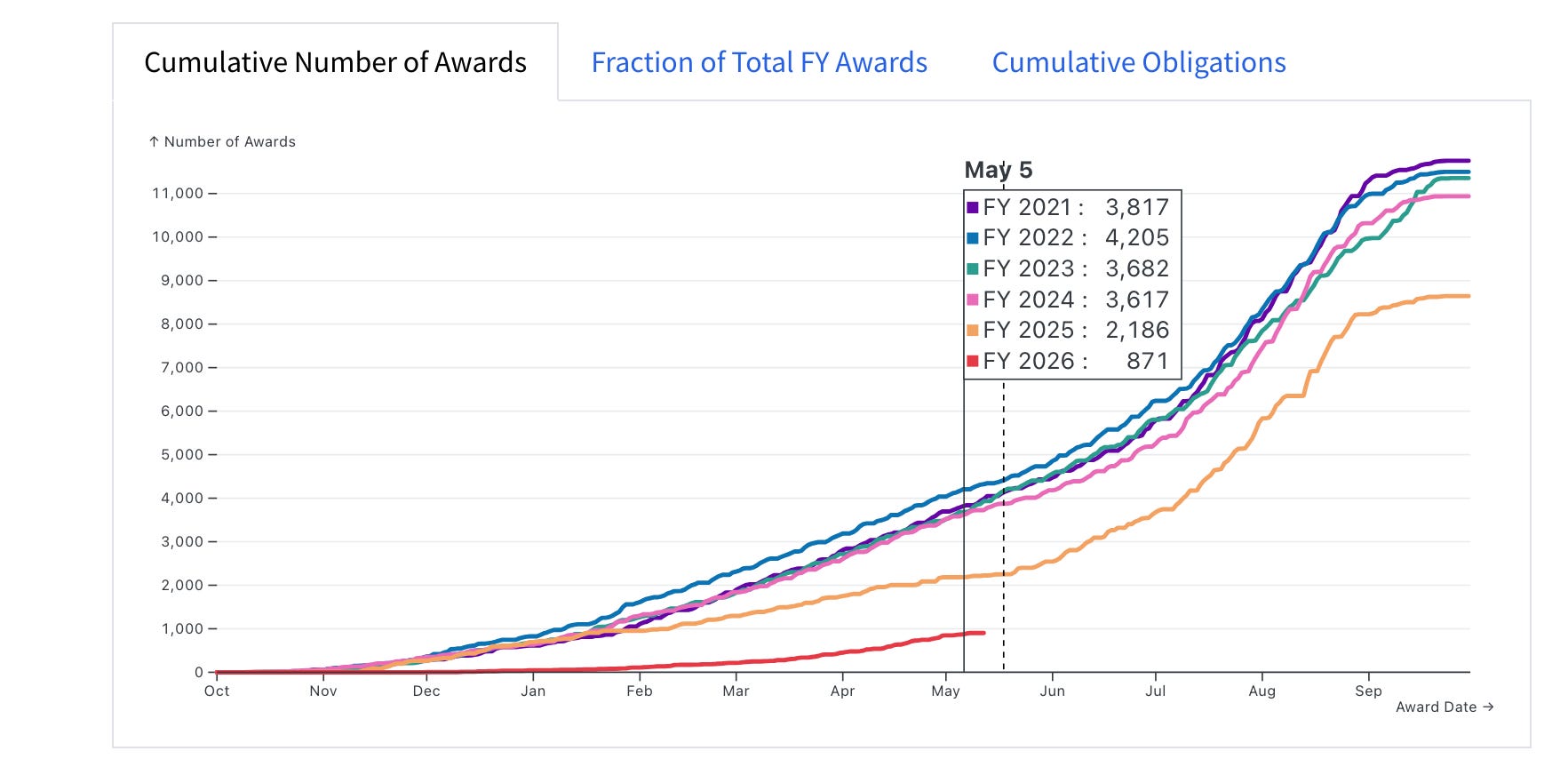
It’s not entirely clear why; one reason is likely just that many program managers have been fired, so those that are left are having trouble doing the work it takes to get awards out the door. But this was an easily foreseeable outcome of DOGE’s actions, so one has to conclude that the Administration wasn’t bothered by the prospect that the NSF’s support of scientific research across the country would be throttled.
And the attacks are not just on NSF. At all the federal agencies that support science, the Administration’s hostile takeover has overturned the processes of research funding, creating uncertainty and confusion at best and shutting down laboratories at worst. Research universities are in crisis, to varying degrees but with few total exceptions; even the strongest ones, like MIT, are struggling.
Besides funding, the other essential ingredient in American scientific success is talent, much of which comes from outside the U.S. Aspiring young scientists come here from around the world as graduate students and postdocs. They are drawn here by the research funding, the institutions and talent already here, and the relatively open and meritocratic ecosystem. Many stay here, start companies, and contribute in innumerable other ways. Now, the Administration’s many anti-immigration actions and policies have reduced the scientific talent pool coming from overseas, and demoralized, if not driven out, foreign scientists already here. Some U.S.-born scientists are leaving the country too — I don’t have numbers, but I know quite a few myself, either personally or at one degree of separation, who are taking jobs outside the country.
It’s normal that an elected government should want to set policy, and that this should include some degree of oversight of federal agencies. But one would also hope that any Administration who inherits a world-leading scientific enterprise would recognize the value of it enough to see that they shouldn’t take actions that risk destroying it.
And scientists can’t do their best work without a reasonable degree of independence and stability. To put scientific institutions under the degree of political control this Administration seeks is, if not to destroy them, at least to render them shadows of their former selves.
The system has had no shortage of flaws, of course. Plenty of research is more routine than truly innovative. (It’s just not all that easy to identify ahead of time what research will turn out to be groundbreaking and important, so no one has found a way to fund only that.) The processes and institutions have their shares of biases and dysfunctions. Intellectually serious critics can recognize the successes of the system, while arguing for reforms to remedy its failures.
But the Trump administration is not an intellectually serious critic. These draconian budget cuts, firings, and overturnings of process and precedent, made at this speed, with no apparent deliberation and little or no input from scientists (other than, sometimes, scientists handpicked to say what the Administration wants): these show a willingness to destroy the existing system, or at least a tolerance for damage to it, that no one who recognized and understood what that system has achieved could possibly hold.
The United States’ economic prosperity has been built in no small part on its world-leading success in science and technology. (See, for example, here, here, or here.) The ingredients of that success are generous federal research funding, intellectual freedom, and openness to foreign talent. Remove these ingredients at the nation’s peril.
But while the contributions of federally-supported science contribute to national well-being in many ways, most of those ways are collective, gradual, and indirect. Research at universities and government labs generally leads to prosperity only after multiple downstream steps of translation. It doesn’t usually produce products, services, or improved public policies directly, but informs and enables those things. We’re more like the foundations of the house than we’re like the firefighter who drives up and saves it.
To the average nonscientist, then, the consequences of the Trumpist assault on science may not be seen or felt as immediately as those of closing the Strait of Hormuz. But if the Administration gets everything it seems to want, they may ultimately be even worse, and longer-lasting. Institutions, and the intellectual cultures that live in them, are much easier to destroy than to build. Damage the Foundation, and it’s hard to make the building stand strong again.
Been thinking a lot about this as well, Adam. Being critical enough to recognize flaws within, and perhaps even become disillusioned with, our present systems for healthcare, education, science etc. while also reminding myself that I fundamentally believe in the value of science (and the benefit of pooling collective resources for it) in a well-functioning society is a difficult balance to strike! But perhaps what people need to believe is a dream for a better future? Not just a warning of a possible nightmare scenario. Not sure yet what that would look like…
So well said. And such a bummer. Thank you for this. (Though it’s more fun to read about Sumner!)