
Save NCAR
Field notes from New Orleans, where I and 20,000 colleagues learned that Trump intends to destroy the National Center for Atmospheric Research.

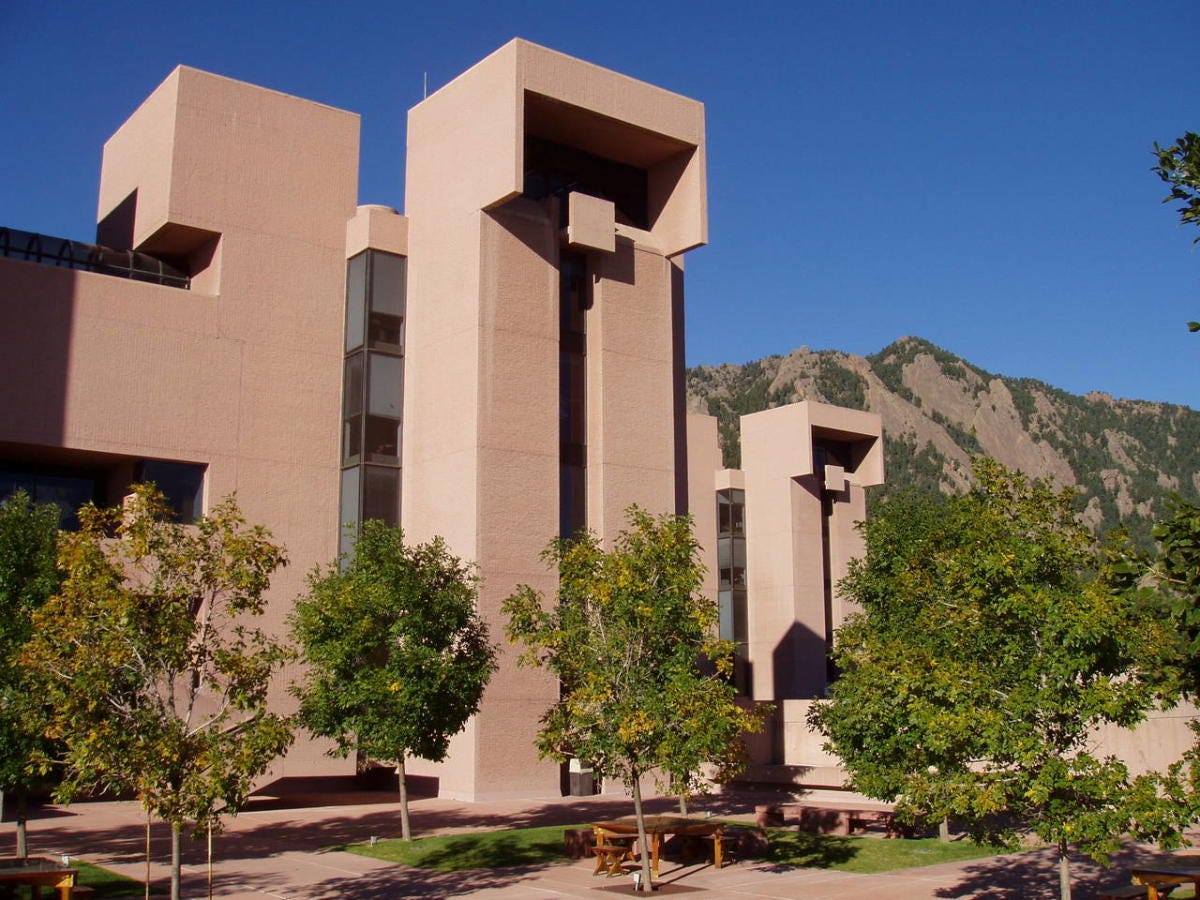
We saw the USA Today article on Tuesday evening. I was at the social gathering that my home institution, Lamont-Doherty Earth Observatory of Columbia University, puts on annually at the Fall Meeting of the American Geophysical Union, held this year in New Orleans. The headline: “Trump moves to dismantle major US climate research center in Colorado.” That center being, the National Science Foundation’s National Center for Atmospheric Research (NSF NCAR, or just NCAR to most of us), in Boulder.
AGU is the largest regular gathering of earth scientists in the world, with 20,000 this year. That’s a big number, but smaller by a third than the 30,000 last year, due to the U.S. government’s slashing grants, denying permission for federal scientists to travel, and scaring overseas scientists away from coming here.
The meeting is always overwhelming. I invariably leave feeling simultaneously overstimulated by all the science I saw and heard and depressed about all the science I missed. Most of all, it’s a chance to catch up with old colleagues, students, mentors, and friends. But this time, to our great distress, it was also a place to begin organizing to resist this latest assault from Washington.
At the Lamont event, I had been talking to a youngish NCAR scientist. She is extremely talented and capable, someone originally from another country who could easily get a good job back home if she wanted to. She has made her career here because, at least until now, the U.S. has been the global center of gravity for science in general and atmospheric research in particular.
And my colleague’s employer is aptly named: it is indeed the National Center for Atmospheric Research. NCAR’s scientists do a lot of important research in house; but more than that, their lab is a hub that connects and enables the research done by everyone else. It’s hard to find anyone in atmosphere, ocean or climate science who hasn’t been to NCAR for a workshop or summer school, hasn’t used their supercomputers, run their models, been on field campaigns with their planes or radars, or collaborated with their staff scientists. I have done all these things, some of them many times.
In response to my asking her how things had been during this last challenging year, my NCAR colleague had been telling me that, despite all the chaos and stress of the last year due to the Trump administration’s attacks on science in general and our field in particular, she was still feeling pretty good about her job and glad to be at the lab. I turned away to talk to someone else for a few minutes, and when I turned back she said “Adam, I’m changing my answer.” Someone had sent her the story.
By the next day, the entire meeting was in a state of shock, dismay, anger, and confusion. No one --- not NCAR scientists or administrators, not NSF program managers --- knew any facts, other than the intent expressed by the statements in the USA Today article:
“The National Science Foundation will be breaking up the National Center for Atmospheric Research in Boulder, Colorado,” Russ Vought, director of the White House Office of Management and Budget, said in a statement to USA TODAY. “This facility is one of the largest sources of climate alarmism in the country. A comprehensive review is underway and any vital activities such as weather research will be moved to another entity or location.”
We asked ourselves and each other: how can they do this? Even just the practicalities of it were difficult to grasp. NCAR is not actually a federal agency; it’s operated by the University Corporation for Atmospheric Research (UCAR), a consortium of universities. Its employees are not feds, and while the government can defund them, I don’t think it can actually fire them. I’m still unclear about who owns the famous Mesa Lab building, or whether the federal government has the legal right to put anything other than NCAR there. What about the supercomputers, which are actually in Wyoming --- a red state, perhaps free of the political vendetta against Colorado that seems to be motivating all this? Shouldn’t there be a process for a decision this big, rather than just a USA Today article and a tweet?
The real answer, of course, is that probably none of that has been thought out, by Russ Vought or anyone else, because the tremendous negative consequences of closing a world-leading scientific facility don’t bother anyone behind this decision. Instead, everything about Vought’s short statement proclaims this administration’s disdain for science.
Calling NCAR a “source of climate alarmism” would be laughable, if the consequences weren’t so deadly serious. NCAR is a research lab and a national facility. It is a source of alarmism only in that some of its climate research can cause alarm, at least to anyone whose ideological orientation doesn’t prohibit them from taking it seriously. But in this, it is no different from any other lab in the world that does climate research. Presumably, Vought would close them all if he could, declaring any attempt to understand the behavior of our planet’s atmosphere and oceans as “woke” and a “green new scam.”
We scientists can, however, apparently avoid those epithets if we don’t study the atmosphere’s behavior over periods longer than a few weeks into either the past or future, such that we aren’t compelled to consider the influence of fossil fuel burning. Because while climate research is “alarmism,” weather research is, according to Vought, “vital.”
Only a modest fraction of NCAR’s research is about climate change in any direct way. The rest is about weather forecasting, solar physics, air quality, or just the basic science of how the atmosphere works. But it’s all connected. Weather and climate are just words that describe the behavior of the same system on different time frames. Tools, results, and understanding built for one inform our understanding of the other. Calling weather research vital while moving to shut down climate research makes no sense, except as a disingenuous fig leaf over a callous anti-science ideology. Would you want to be treated at a hospital whose policy prohibited its doctors from considering how their treatments might affect you on any time horizon longer than a week or two?
The fact that the announcement happened during AGU had the slight silver lining that it allowed quicker organizing, over a larger cross-section of the community, than would have been possible otherwise. AGU itself quickly put together an in-person Town Hall where Tony Busalacchi, the director of UCAR, spoke. Letters and op-eds were drafted (for example, Marshall Shepherd and Ben Santer explain the value of what NCAR does in more detail than I’m doing here), and calls and emails made to elected representatives (make your own with the AGU script).
The early career scientists who had, months earlier, organized the hundred-hour Weather and Climate Livestream --- in response to the Trump administration’s previous threats to close the National Oceanic and Atmospheric Administration --- sprung into action again, interviewing many at the meeting to put together a video advocating for NCAR. I wish that some of our field’s best young talent didn’t need to spend so much of their time and effort opposing their government’s repeated moves to shut down their field, but I’m tremendously impressed by their organization and commitment.
The outcome remains unknown. Colorado’s two senators have held up the federal appropriations deal that was almost in place. Many Republicans in Congress (not to mention Democrats), recognize NCAR’s importance. And maybe, months after the early onslaught of DOGE assaults on federal agencies, they are even beginning to grasp the terrible precedent that is set, the downward spiral on which the country is launched, when a President destroys invaluable national assets with no justification beyond personal revenge and pro-fossil fuel, anti-environment ideology.
In the meantime, I stand with my colleagues and friends at NCAR. They don’t deserve this. The work they do is indeed vital, whether its time scale is short or long.
Very well stated, Adam. I've been way too pi$$ed off to organize my thoughts as eloquently as you have.