
The Sumner Files: Juvenilia, Part 2
Drawings of musicians, and the confluences between music and visual art in young Sumner's consciousness.

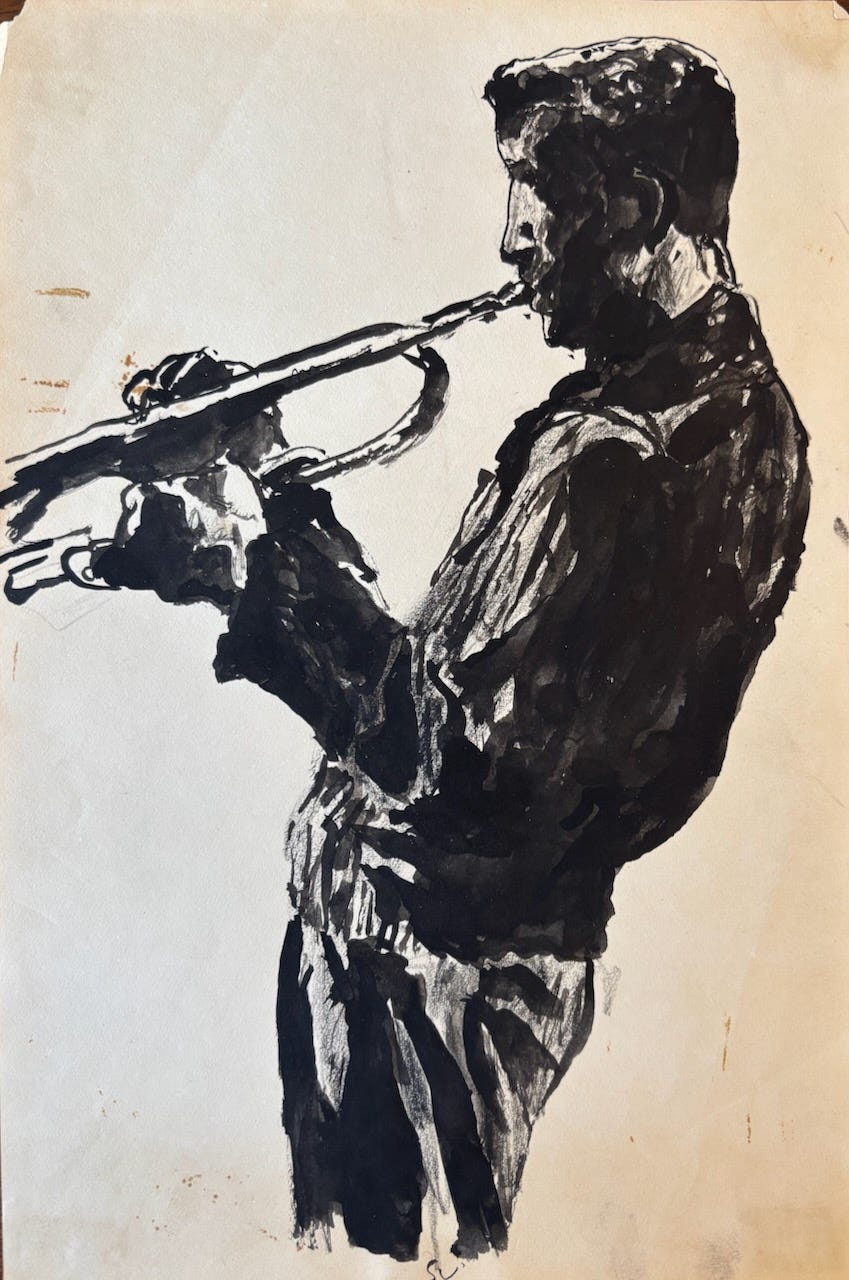
In the folder in his archive labeled “Juvenilia,” containing drawings Sumner did as a child, are some superheroes and other kinds of comic book characters, as we saw last week. The other category of subject matter that stands out, with multiple finished drawings of similar types, is musicians.
At top is an ink-on-paper work, in a style that I haven’t seen in Sumner’s archive outside of this folder — that is, I haven’t seen anything like it in his adult works. It looks like a painting, in that the black ink clearly looks like it was mostly applied with a brush, but some lines, particularly the outline of the head, are so fine that they could have been done with a pen. I suspect that it was based on a photograph, and thus that the subject is a real person. My best guess is Chet Baker. Baker was not an artist for whom I remember Sumner ever expressing admiration, but it looks a little like him; in any case it is clearly a white man, and Baker was probably the most popular (and certainly the most photographed) white jazz trumpet player of the era.
This is one of several similar works, all of which had tape marks at the corners of their back sides, indicating that they had been stuck on a wall. So whether because he felt pride in his work, attachment to the subject matter, or both, these works meant something to Sumner that he wanted to see them every day, during some period of his youth.
Sumner turned fourteen in 1960, and I think he had to have been at least that old when he did these. For one thing, they show a strong interest in jazz, and he was still focused on rock’n’roll in his early teens (see below for some direct audio evidence of that). He left home in 1965, at nineteen, and sometime around then became a student at the New York Studio School, where he focused on painting and came under the influence of Milton Resnick. Though I have no way of being entirely certain, I think it unlikely that these were done after that. So all things considered, I’m dating these “early 1960s.”
I’m pretty sure this one is Thelonious Monk:
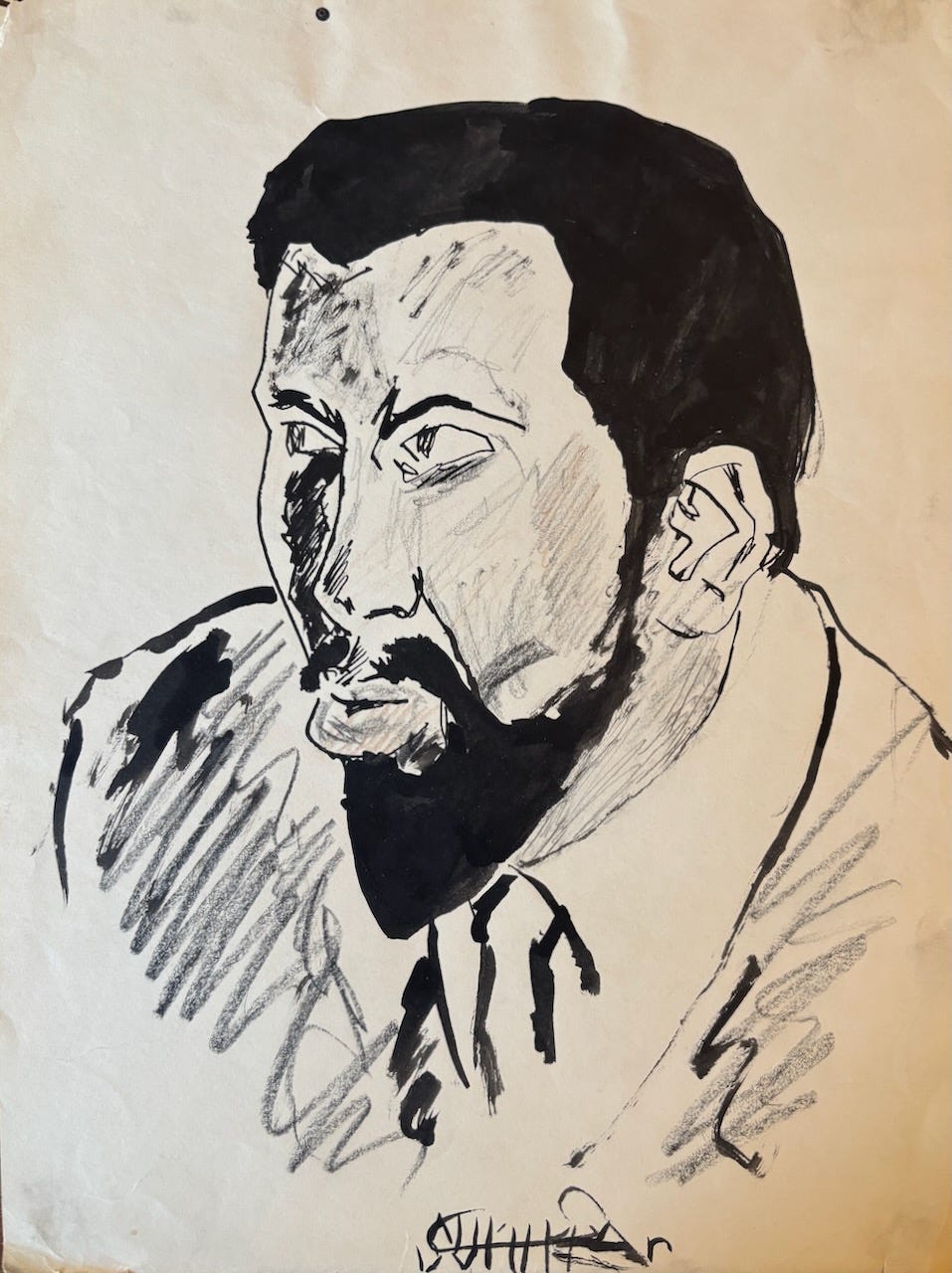
It’s not a great likeness of Monk, in my humble assessment. Sumner’s ability to capture faces apparently hadn’t yet reached the level it would later. But the facial hair resembles that Monk had for much of his career, and Monk (unlike Baker) was one of Sumner’s lifelong artistic heroes. The way Monk took profound originality to the point of oddity; and his music’s combination of romantic beauty and even childlike simplicity on the one hand with dense complexity, rough edges and sharp corners on the other; all this spoke to Sumner from early on — and to me too, when I discovered Monk in my own teenage years, and Sumner and I connected over him.
Among the small subset of Sumner’s records that have made it into my possession are a couple of Monk’s. He was listening to them during the No Wave period, as well as before and after. I am certain he heard Monk perform in person at least once, and perhaps multiple times, as Monk lived until 1982, when Sumner was in his mid-30s. Sumner’s adult piano playing, preserved on some recordings from his basement apartment in the 80s that I’ll share eventually, was clearly influenced by Monk. Arto Lindsay ,in the first conversation that he and I recorded, recalled that Monk was a big influence not just on Sumner, but on their whole group of No Wave artists in the late 1970s and early 1980s: “I mean, he (Sumner) was also obsessed with Thelonious Monk, as and we kind of all were at that time, you know, that he was kind of … summed everything up for us in many ways.”
Here is another one in this series:
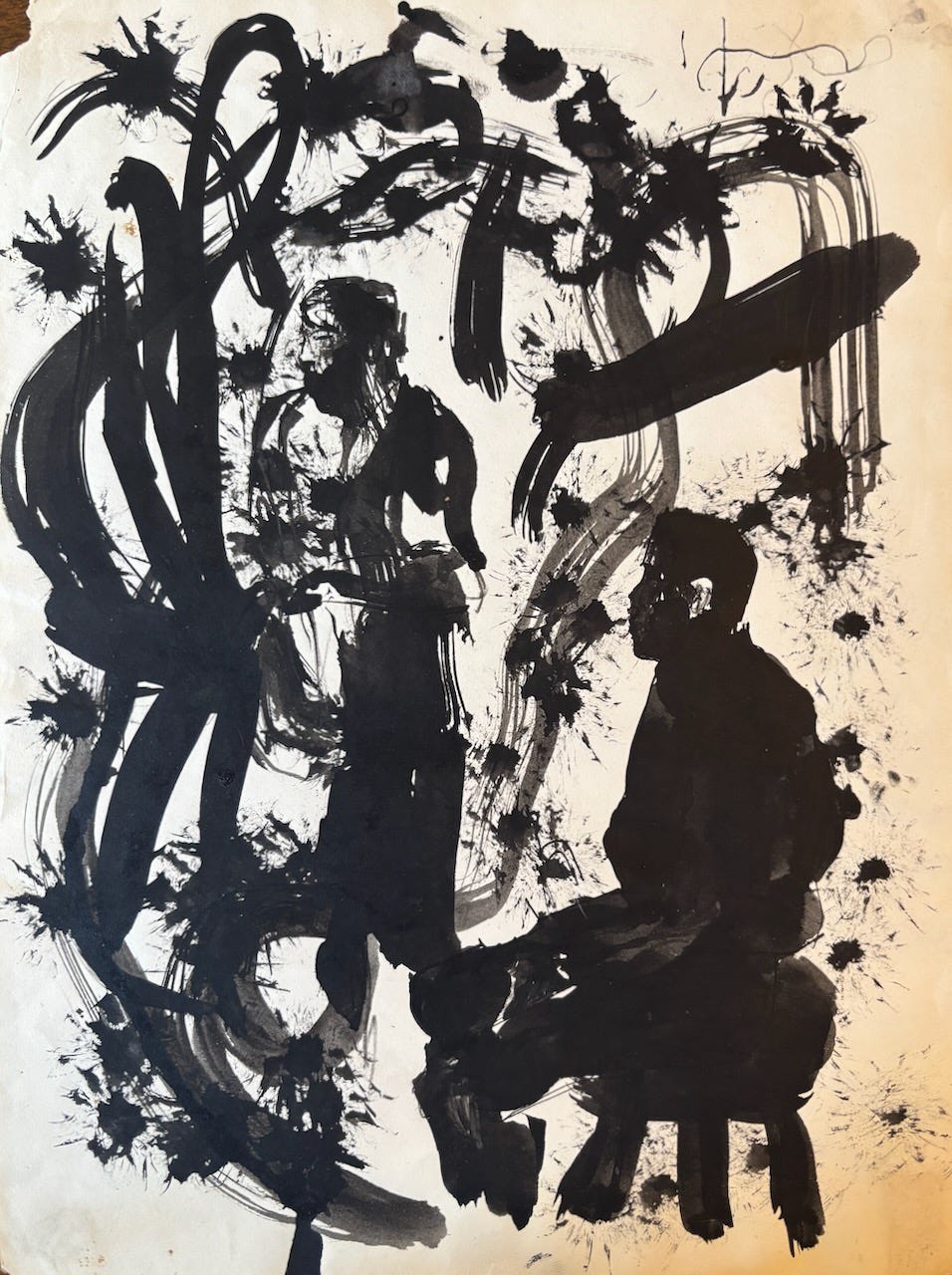
I can’t identify the musicians, nor do I know if they were based on real models at all, but this one is interesting because of the element of abstraction in the brushstrokes and ink splotches, apparently an experiment, in that it isn’t repeated in this set of works, or in any of Sumner’s early work. He had abstract phases and figurative phases, but generally didn’t combine the two like this (at least not until near the end of his life, when he did some more experimenting).
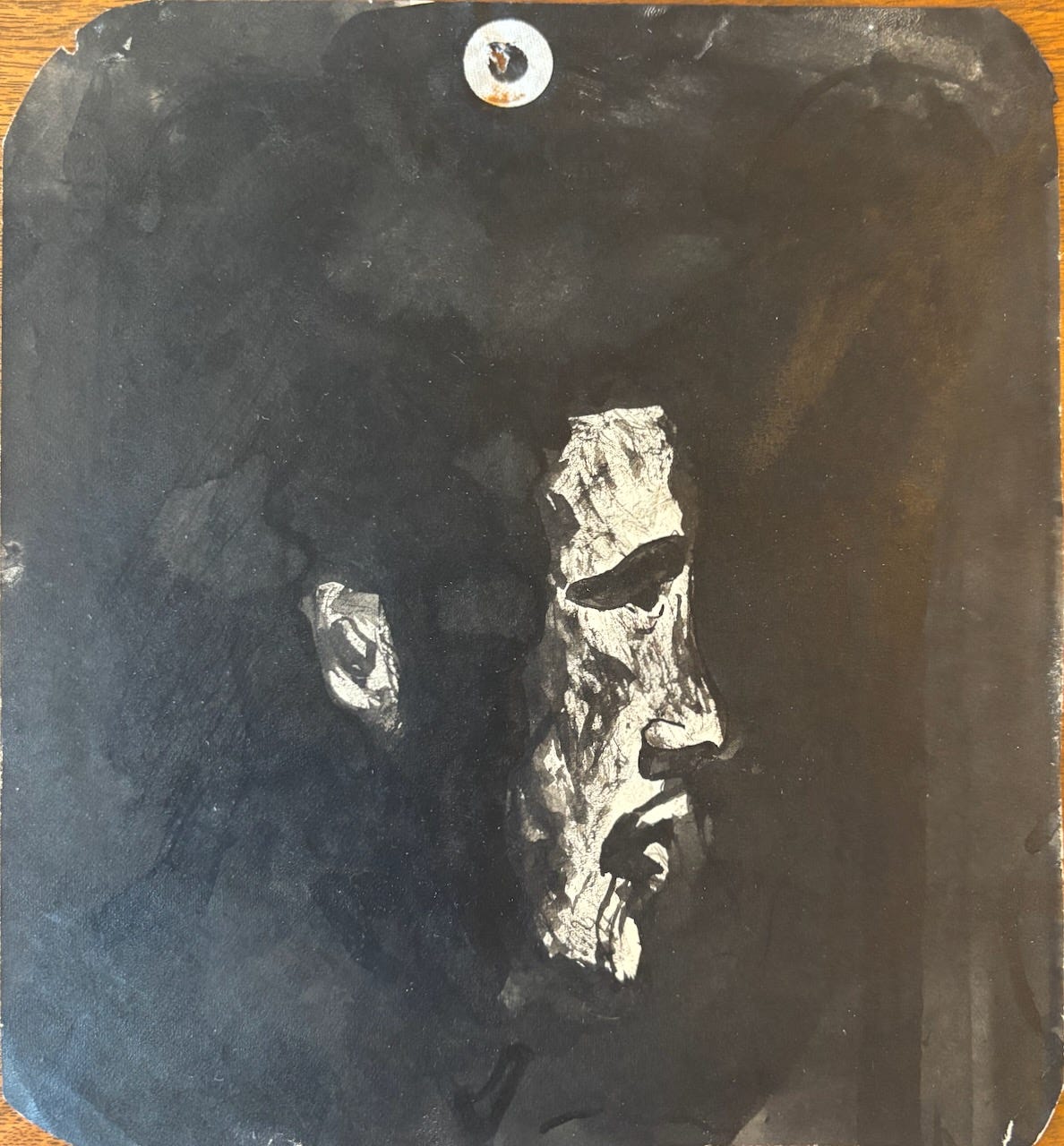
I don’t know who the model is for this next one. I can’t be sure it’s a musician at all, but I suspect it is. It’s also different from the others in its black background, defining the profiled face in negative space:
Who is the singer at top in this next one?
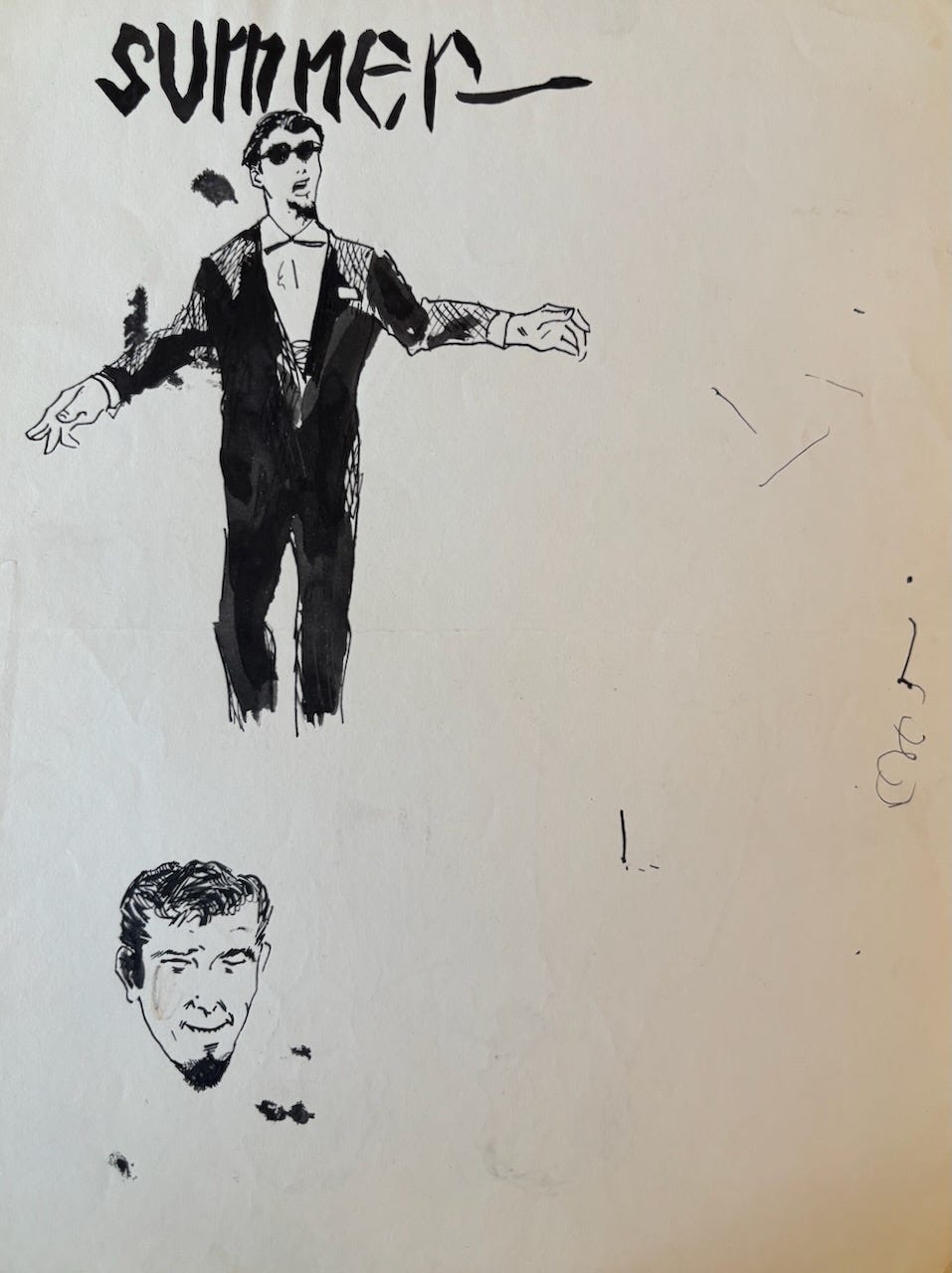
The sunglasses suggest someone blind, but he also looks like a white man, and my limited knowledge of 1950s pop music (augmented by internet search) doesn’t reveal anyone famous who fits this description. He could be a fictional character. I don’t know if the face at bottom is meant to be of the same person or not, either.
This next one depicts an imaginary band, whose members’ names I am pretty sure Sumner invented, although the horn player’s look clearly draws on Dizzy Gillespie’s:
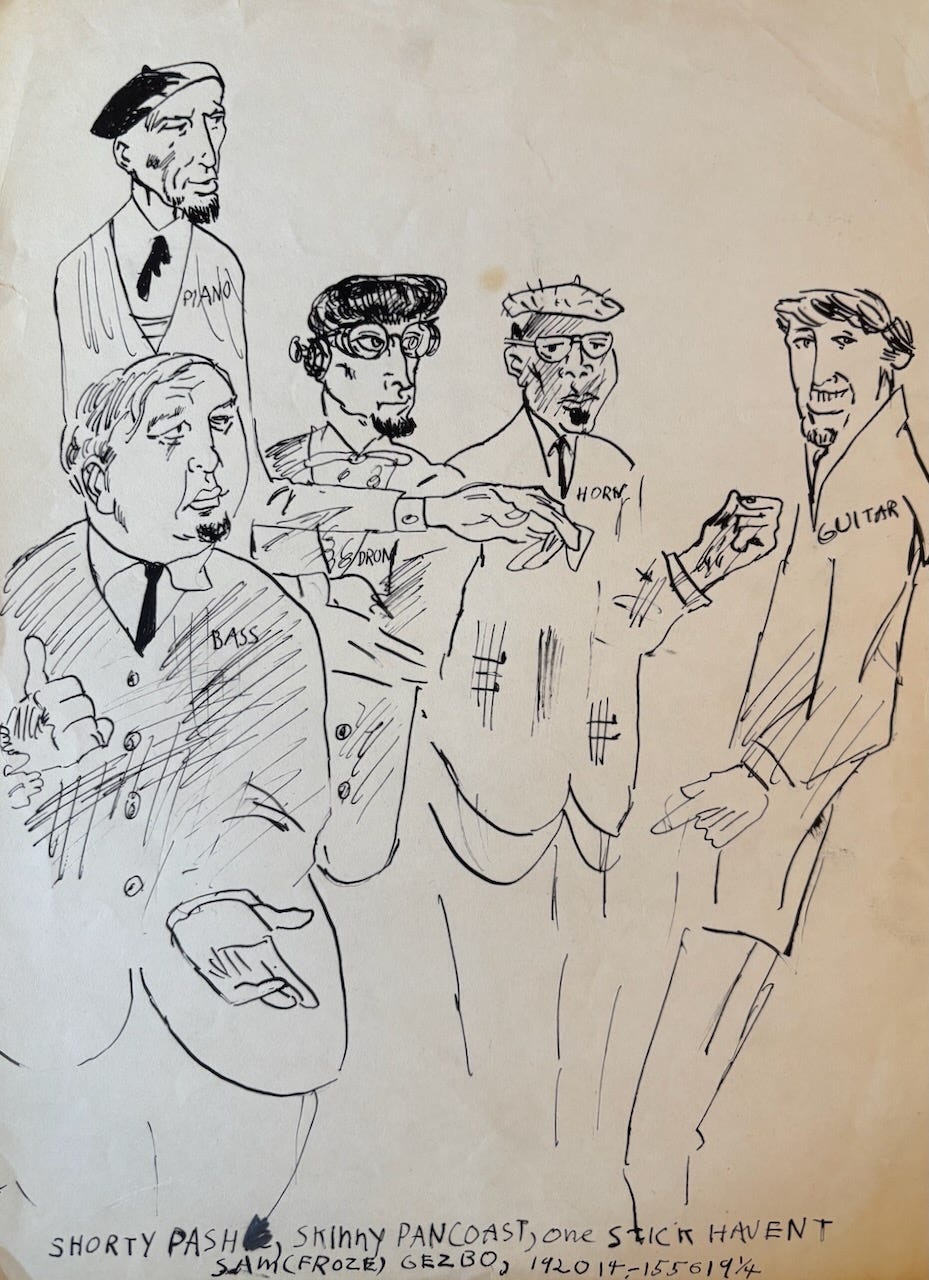
I have no idea to what the numbers after the names refer. The style here matches that of the other comic book – inspired drawings in the folder, but Sumner didn’t sign this one, denying us the evidence that the gothic font (as in the Monk and unnamed singer above, and some of the drawings from last week’s post) would have provided. I believe nonetheless that it is from the same period.
This next one, on the other hand, was surely done earlier:
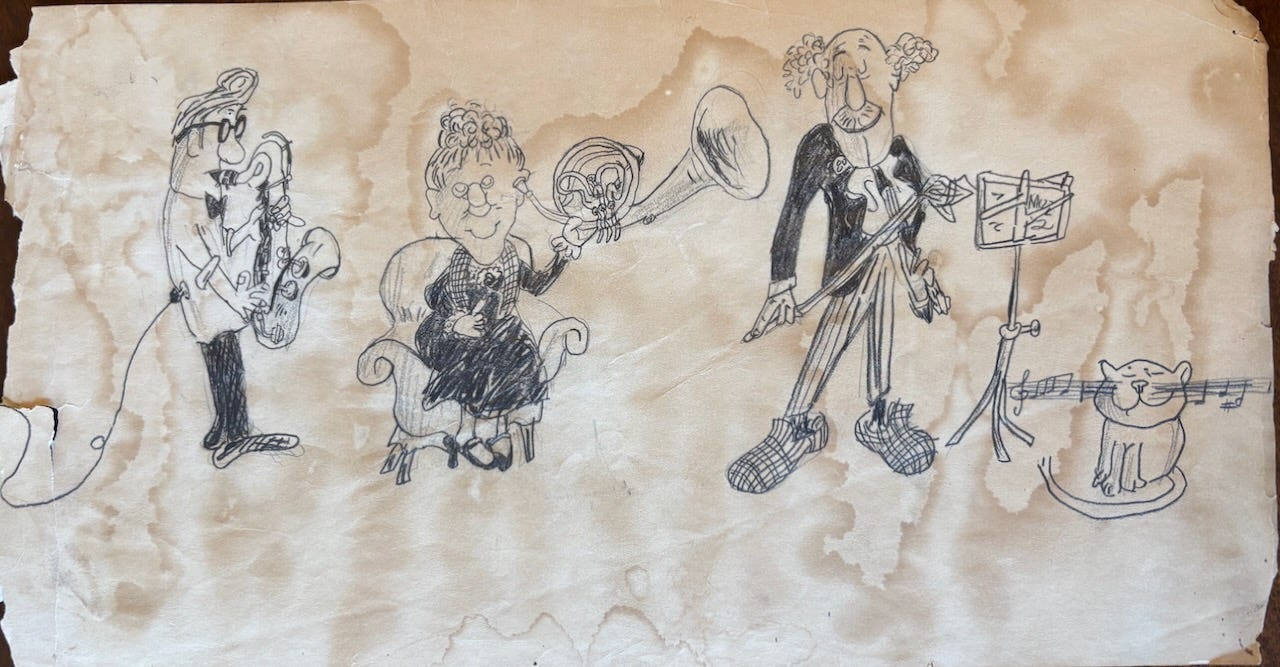
It too shows musicians, but they don’t look like the ones further above. Rather than comic books with superheroes and soldiers and cowboys, this one, to my eye, looks more influenced by newspaper cartoons. I can’t be certain, but I speculate that Sumner drew this no later than his early teenage years, and perhaps earlier — but older than nine for sure, as it’s substantially more advanced than the drawing he did at that age that we’ll see below (don’t peek yet). The stained paper and ragged edges indicate that it wasn’t originally preserved in the same batch as the others. I suspect that Sumner’s parents, rather than he himself, first set this one aside.
Why is the saxophonist plugged into the wall, as though he himself were electrically powered? Why is the old lady sitting in a comfy chair, and just holding up but not playing her brass instrument (something like a French horn, but not quite that)? Why is the violinist wearing what look like puffy slippers, and why is there a cat with musical staves where its whiskers should be? I have no idea, but they suggest an unknown story behind the picture, or a fertile imagination at a minimum.
Going back in time even further, this piece of paper, in the same folder, is unique for having a date written on it: New Year’s Day, 1956, when Sumner was nine years old. It shows notes from a piano lesson:
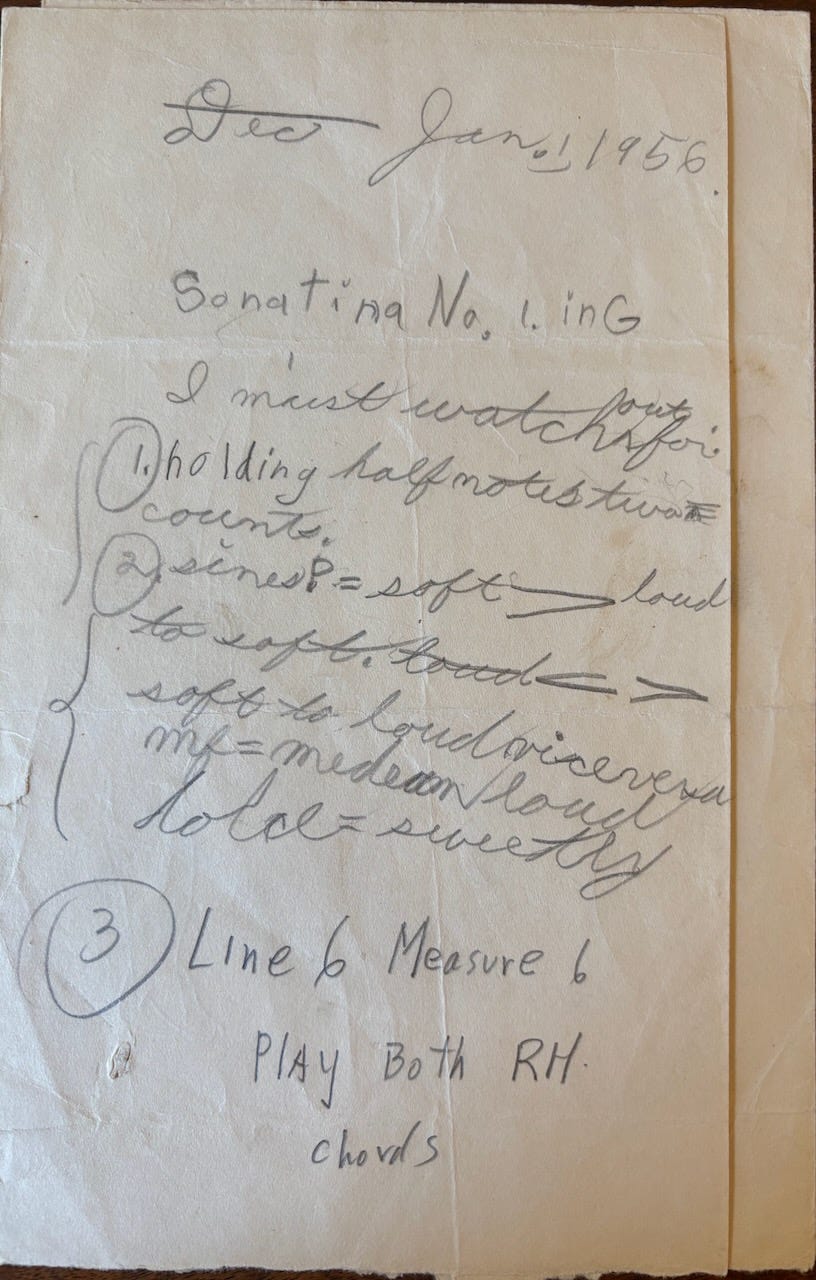
The teacher was surely Sumner’s father, Charles Schoenwetter. Charles — grandpa Charlie to me — was a music teacher by trade, supporting his family by giving private piano and violin lessons for many years before eventually (I believe a little later than this) getting a job as a proper teacher at Andrew Jackson High School in Queens, where he conducted the orchestra as well as teaching all the students how to play their instruments.
Both Charles and Sumner’s mother, Sylvia Schoenwetter (neé Cross) were children of immigrants, all Eastern European Jews. Sylvia had two brothers, one of whom, Eddie, was killed serving in World War II; Sumner’s middle name, Edward, was for him. Charles was the eldest of five sons. His father, Abraham Schoenwetter, was a cantor, that is, someone who sings prayers in religious services, so the family’s musicality goes back at least that far. Charles was trained as a rabbi before, as an adult — and, apparently, a communist, though neither he or my grandmother ever spoke about that aspect of their lives to me, and my mother still has difficulty doing so — he eschewed religion entirely. He graduated from City College, and was proud of his learning. I remember him as a kind grandfather, if a bit stiff. He was strictly a classical musician (I first wrote “classically trained,” but that is not true, as to the best of my mother’s knowledge, he was almost entirely self-taught) who didn’t think much of any form of popular music.
At one point or another, Charles gave music lessons to both of his children. He was not, on my mother’s account, an attentive teacher; in the interview she and I recorded for the podcast, she recalled a story I had heard her tell throughout my life, of him being half asleep in the next room during her “lesson”, but rousing when she hit a wrong note:
“So he would, I would be sitting at the piano and I would be playing my little ‘deedle deedle’. And he would be sitting in a big soft chair. And I would hear from the other room, ‘F sharp! B flat!’”
My mother never learned to play the piano very well. Sumner did, but I don’t think my grandfather deserves much credit for it, beyond genetics, the initial encouragement, and the environment of a musical home.
By his early teenage years, Sumner was consumed by early rock’n’roll. His musical role model was Jerry Lee Lewis, someone my grandfather couldn’t appreciate. Twenty years later, he couldn’t appreciate Mars or John Gavanti either.
The most striking thing about this piece of paper from 1956, though is that it shows the confluence of music and visual art, or perhaps the conflict between them, in young Sumner’s life, and the family dynamic that contained it all. The paper is folded over, and inside it is a drawing:
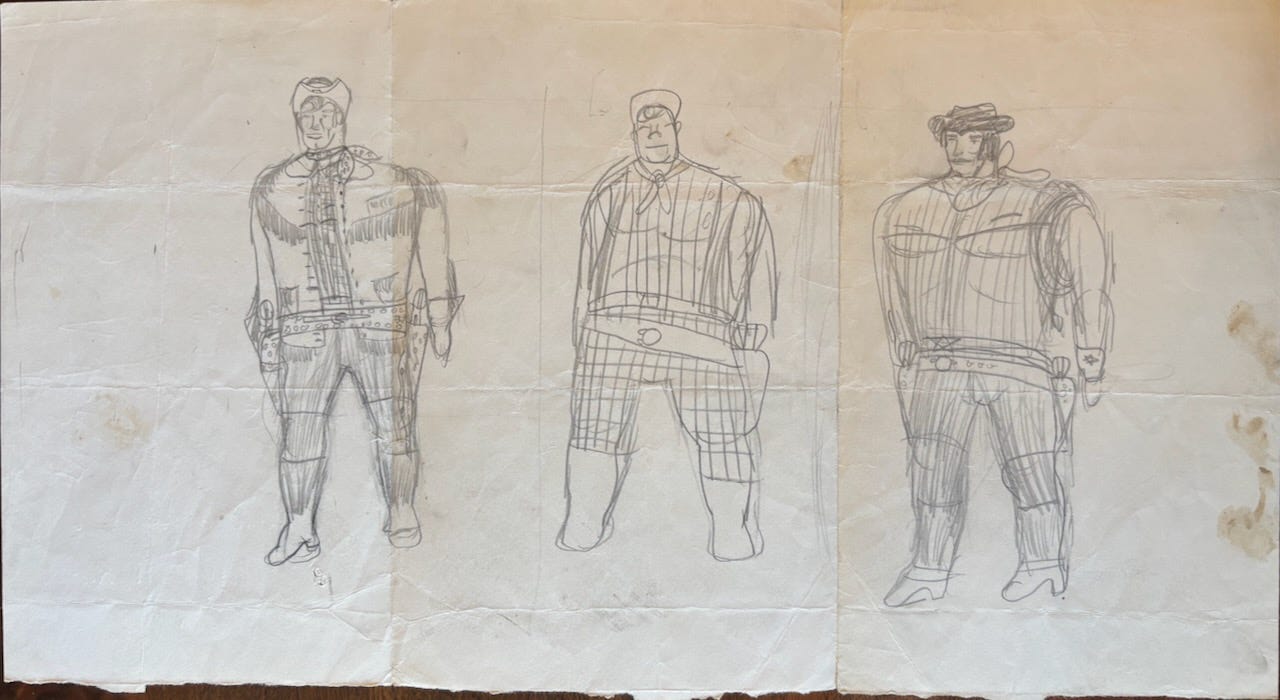
Let’s imagine the scene. Nine year old Sumner, a naturally talented musician but not someone who ever took particularly well to formal instruction, is getting a piano lesson from his somewhat stiff, classical musician father. The piece is Beethoven’s Sonatina No. 1 in G, an easy one taught to beginners everywhere. Charles, frustrated with his son’s progress, makes him write down the things on which he should focus his practicing, including dynamics (“soft to loud”) and duration (“holding half notes two counts”). He wants Sumner to know what the Italian adjectives mean: as he makes him note that “dolce = sweetly,” we can, with the benefit of historical knowledge, anticipate Charles’ future disappointment at Sumner’s musical direction.
That direction including, to add some audio from the archive here: the percussive and distinctly not “dolce” accompaniment to Lewis’ “Breathless”. This recording was made by Charles, who owned a reel-to-reel tape machine, in 1959, when Sumner was thirteen, with him on piano and his friend Tommy Reina on guitar. I am not sure who is singing, but I am pretty sure the voice at the beginning saying “willya shut it off, dad?” is Sumner’s, and I’ve left it there so you can hear his childhood Queens accent.
But back to New Year’s day, 1956, when Sumner hadn’t yet learned to play like that. The lesson is over, Charles moves on to the rest of his day, and it’s time for Sumner to practice on his own. Instead he unfolds the paper and, daydreaming of Hopalong Cassidy, the Lone Ranger, or one of the other western dramas of the day, draws three stocky cowboys, belts sloping jauntily to one side, pistols holstered, kerchiefs knotted about their necks.