
Creativity in science: why talk about it?
Because we usually don't, and we aren't good at teaching it either.

This is the first of what I intend to be a few posts on creativity in science. My larger intent, at which this first piece only hints, is to think through the connections between science and art, motivated by my research and writing about my late uncle, the artist Sumner Crane. It’s the beginning of a more explicit articulation of what Sumner’s life and work have to do with my own work as a scientist. Because neither Sumner nor his art appear further in this post, I haven’t labeled it “The Sumner Files,” but it’ll all be connected eventually.
One further note: I don’t actually provide an explicit definition of scientific creativity here. I’ll attempt that later. I hope this first installment makes enough sense without one.
Why talk about creativity in science?
Because it’s important, and interesting, and beautiful.
Science is a creative activity. At least, it is when it’s any good. Major scientific discoveries are creative achievements, and creativity is what distinguishes great scientists from not-so-great ones.
And yet we scientists talk about scientific creativity very little, and teach it even less, even though it’s at the core of what science is.
The teaching of science tends to emphasize settled knowledge. To the extent that students are taught anything at all about the origins of that knowledge, accounts of the “scientific method” emphasize the testing of hypotheses (how we determine whether ideas are right) over their generation (where ideas come from; i.e., the most creative part of the process).
Even at fairly advanced levels, like upper-level undergraduate courses in the physical sciences, mastery is measured mainly by one’s ability to solve pre-determined problems using pre-determined methods1. This teaches important and necessary skills, but sheds little light on how anyone first came up with either those problems or those solutions.
Then, once students graduate and become working scientists, our jobs can sometimes seem designed to suppress creativity.
The peer review system, for example, can be deeply conservative. Grant proposals should be among our most creative forms of scientific expression, since they’re where we are supposed to put our best new ideas. They are typically sent to several reviewers, either working independently (“mail reviews”) or collectively (panels) for comments, before a program manager makes a decision about whether to fund the work. When resources are scarce, as they usually are, even one negative review can sink one’s chances; so it’s less important to get great reviews than it is to avoid bad reviews. One learns to make reviewers feel good by saying things they already know, extending established lines of inquiry in incremental steps, presenting work that’s already half done (in order to assuage doubts about whether it’ll work), and altogether introducing novelty only in small, unthreatening doses.
Then, if we’re lucky and our proposal is funded, most of the work (at least in universities) is done by graduate students and postdocs. Their own creativity is suppressed, to the extent that they are told to work on the pre-defined problems that their mentors just got through peer review.
This direction of trainees makes some degree of sense: how else would a typical graduate student, new to the field, know what to work on, or how to work on it? Formulating a good research question, and then a strategy to answer it, require taste2, knowledge of the literature, and intuition. All of these are generally acquired through the hard-won experience that early career researchers don’t yet have. It’s only practical and logical that their mentors, who do have that experience, would set the agenda, at least at the beginning.
But when and how do junior researchers learn to set the agenda themselves, as they’ll eventually need to if they’re to succeed and become senior researchers? The ability to formulate good questions is not something that we teach in the classroom, or in any other explicit way. It’s a muscle that one needs to train, and there isn’t much in the way of systematic or formal mechanisms built into the system for students and postdocs to exercise it. The expectation seems to be that it will happen in the course of the apprenticeship process, but that’s far from guaranteed. Ingredients that promote it include: funding that is reasonably stable and not too tightly tied to specific timelines or deliverables; supportive mentors; and most of all (but most out of the control of the mentor), self-motivation on the part of the junior researcher themselves.
Good mentors give their mentees space to experiment. I was given that space when I was a graduate student and a postdoc, long ago. After spending some months or years working on whatever my advisors had initially suggested, I came up with my own ideas and told them I wanted to work on them. To my immense gratitude, they let me do it. Some of those ideas worked out extremely well; others didn’t go anywhere. In either case I learned.
I have tried to pay it forward by doing the same for those in my care. I try to communicate that I’m open to hearing their ideas and will be supportive of their spending some fraction of their time investigating them, as long as the ideas pass some minimal standard of reasonableness. This approach has worked well for those of my Ph.D. students and postdocs who have had the internal resources to make the most of it. To put it another way, what look like my best successes as a mentor have resulted from little more than cheerleading and getting out of the way.
Not everyone has the internal resources to make the most of it, though. The ideas, the drive and discipline to execute on them, and the risk tolerance needed to spend time out on a limb: all these have to come from inside the aspiring researcher. Sometimes they don’t; perhaps because, up to this point, their educations haven’t truly asked it of them.
Letting someone flail at that point can occasionally lead to a breakthrough, but our institutions don’t make it easy to do that for long. There’s too much pressure on everyone involved to produce measurable outputs, particularly publications and degrees, on time and on budget. So we often default to the lowest common denominator: an assignment to take a set of well-defined, incremental steps, laid out by the mentor, in an established direction.
Creativity can still emerge in the execution. Even if the initial direction is set by the mentor, the junior researcher will face many small choices as they move forward. Those who are most effective will be able to make those choices (at least on a trial basis), and work some distance through the consequences, on their own. They will recognize when something is not working, and adjust, without needing feedback or instruction at every step, allowing them to make substantial progress in between meetings with their mentors.
Both great and not-so-great students will make mistakes in their calculations. The great ones develop the context, intuition and critical sense to look critically at a plot3 they’ve made to visualize their results, realize it’s wrong, think about where the error might be, and try to correct it. The not-so-great ones just make the plot and wait to get their advisor’s take on it. The same applies to results that are not wrong per se, but that, on reflection, show that the calculation didn’t make sense, or didn’t address the scientific question that motivated it in the way that one had thought beforehand that it would. Some will realize this and try something slightly different, on their own, without being told anything.
Being able to take an increasing number of such steps unaided amounts to what we call “independence,” but another term might be “creativity in the small things”. It can lead to creativity in larger things, if and when the process of experimentation and assessment of interim results leads to re-thinking of the larger question that underlies the entire project, or of the methodology laid out to answer it.
Not everything has to be learned through one’s own experience as a researcher. As in other aspects of life, one can learn from the communicated experiences of others. Reading the literature, going to talks and conferences, and conversing informally with other scientists, whether one’s peers or those at later career stages all can support the development of the scientific creativity muscle. Role models can inspire us, by showing what success looks like and providing clues to the perceptive about how to achieve it. Conversely, others’ failures can also be nearly as informative as one’s own, if one has the empathy to understand them — and if they let us see their failures in the first place.
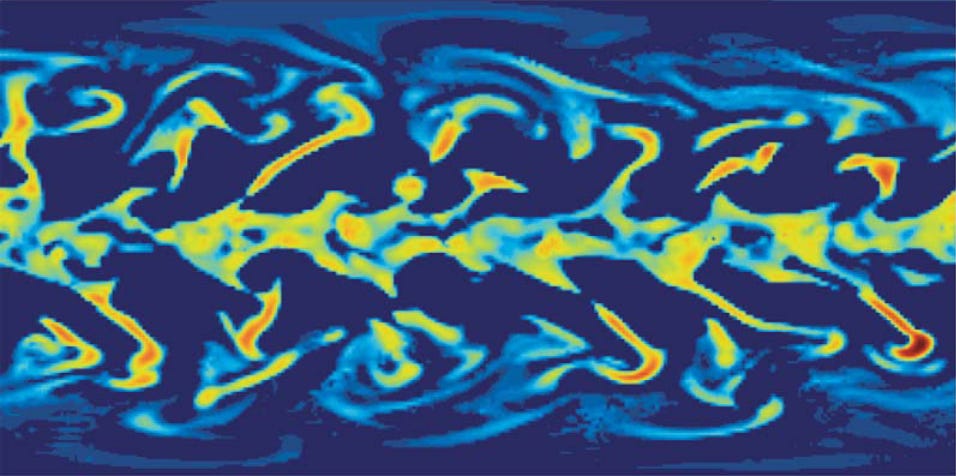
In the mid-1990s, when I was a new-ish graduate student at MIT, Isaac Held came to give a seminar. I can’t remember any of the specifics of the talk beyond its topic, one he’d been working on for years. He had set himself a deep theoretical question, the kind where the real challenge is often how to formulate the problem right more than what one then does to solve it4. I do remember that at the end, he didn’t wrap things up into a set of conclusions — as convention dictates, and as almost any other speaker, then or now, would feel compelled to do. Instead, he just trailed off, saying “Well, I still don’t really understand it, but that’s as far as I’ve gotten5.”
Years later, Isaac would become an important mentor to me, as he has been to a great many others in our field. In this moment, the first time I had seen him in person, he won me over completely. He also modeled several traits that I now think of as contributing to his own prodigious scientific creativity, and which I have tried, with whatever limited success, to mimic.
First, confidence and security: only someone who didn’t feel they had anything to prove could end a talk like that. Second, honesty, self-criticism, and vulnerability: he was willing to let us see not just the polished end of his thought process, but the rough middle, and to admit that he hadn’t yet achieved what he wanted. (You can’t succeed if you can’t recognize failure, and live with it.) Third, vision and determination: he was showing us that he was in the middle of a long arc, with a goal that he kept in view even though he hadn’t found the way there yet, and that he was willing to bang his head against obstacles for years if that’s what it took to find his way past them.
But for a developing scientist to benefit from the available stimuli — talks, papers, conversations, now maybe even social media and AI — they have to be active consumers. They have to learn that creativity and taste in problem selection are at the core of being a good scientist. Then they have to be on the lookout for those who exhibit these traits, learn to recognize them, and take the right lessons from them. One can’t find what one isn’t looking for, and much of what it takes to get to the point of doing a Ph.D. — doing well in classes, maybe an undergrad research internship (often mentored by someone who either has low expectations, guides the work closely, or both) — doesn’t require one to look for it.
Just telling someone what I’m saying here doesn’t work either, in my experience. Altogether, formal education can be critically important in supporting the development of scientific creativity, but I doubt it can make it from scratch. After many years of mentoring, I do feel that I’ve helped some students and postdocs develop into more creative scientists; but to the extent that’s true, it has been by nurturing something that they brought with them into the process. Not everyone brings it. If I knew how to give it to them, I would, but I don’t.
The origin of the spark that leads to true creativity is just as mysterious, just as resistant to explanation, in science as it is in art.
Thanks to Jed for comments on a prior draft.
Never mind that these longstanding pedagogical practices are now being disrupted by AI. That’s a topic for another day.
By “taste” I mean something like “subjective judgment about what kinds of problems are interesting or worth spending time and effort to solve.” It’s essentially the same as what the word means in art or culture. No one can prove that anyone’s taste is right or wrong — and maybe that’s why it’s so little discussed in scientific contexts, as many of us like to think that all the important aspects of science should be subject to evidence, logic and argument — but those who have good taste tend to find or create things that others find valuable, and to do so without needing to be shown the way by others. The “find or” is important because taste is separate from one’s ability to execute or produce. A musician or painter can have good taste, but so can a collector of records or paintings.
"Plot” here just means “graphic visualization of data”. Synonyms would be “graph” or “chart”.
For the scientists: the talk was about the height of the midlatitude tropopause. Isaac was seeking a theory that would explain it from first principles. I believe this was a couple of years before Tapio Schneider, who would eventually take this project forward, came to work with Isaac as a graduate student.
My paraphrase. I don’t remember the exact words, but this was the essence.
Of course I love this, Adam. As I was reading I kept thinking about your background in music….